Google crossed out five GEO shortcuts. I removed two from my own list.
In the week before this article’s May 19, 2026 publication, I saw Google publish an official document called the AI Search Optimization Guide. I opened it expecting another vague update. Instead, it had a full section naming several things people had spent the past year doing “for AI” and saying they were unnecessary. I had done every one of them on my own independent store.
My first reaction was that I had wasted six months. After I went through my GEO list against the guide, the answer was less dramatic: I removed two things, kept three, left one open, and decided to put more effort into one direction. If you run content for an independent store, this is a useful way to separate work you can stop this week from work that still needs a judgment call.
Google’s position in one sentence
On May 15, 2026, Google Search Central published the official guide. This was documentation, not an employee’s post on X. Its central line was:
“Optimizing for generative AI search is optimizing for the search experience, and thus still SEO.”
In plain English, Google treats terms such as AEO and GEO as SEO, meaning the work that helps a search engine understand and surface a page. It did not create a separate discipline for generative search. That position matters because a lot of advice marketed as “writing for AI” starts from the opposite assumption.
Five things Google said not to do
I put the five items in the order I saw them discussed most often:
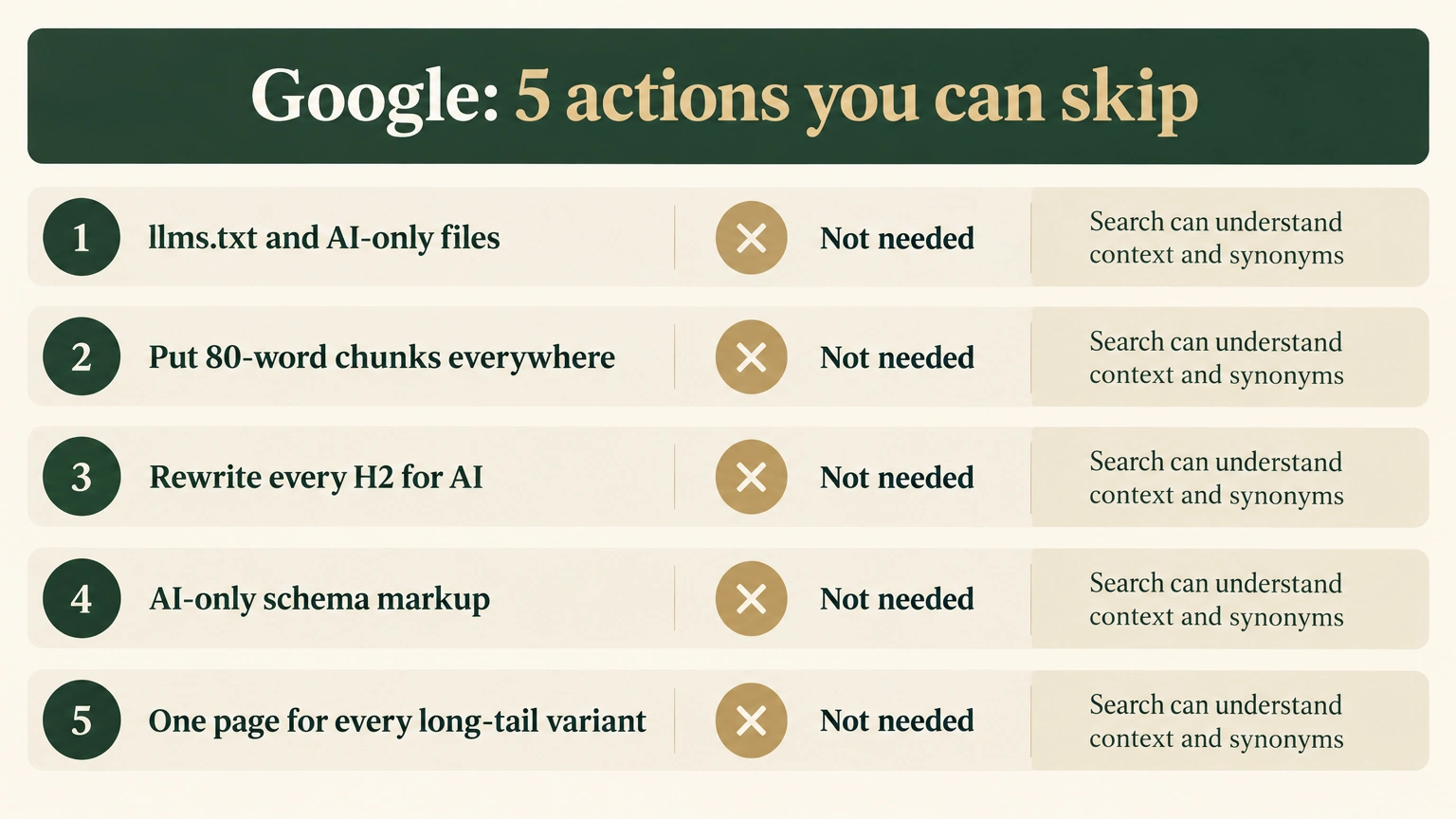
Google's official guide said these actions are unnecessary for generative AI search. The diagram preserves the source guide's five-item list.
llms.txt came first: a file placed at a site’s root to feed content to large language models. Google’s wording was direct: it is not needed. The other four follow the same logic. You do not need to split paragraphs into 80-word fragments, a practice often called chunking. You do not need to rewrite every H2 as a question to flatter AI. There is no AI-only schema markup. And you do not need one landing page for every long-tail search variant.
Google’s reason was consistent: its systems can understand synonyms and page-level context. A readable page does not need to be cut into slips of paper before an adult can read it. The guide also warned against staging fake discussions on Reddit or Quora to make it look as if users are talking about a brand. That is more than an unnecessary tactic; it can be caught by quality filters.
What I removed, kept, and left open
Over the previous six months, these were the six GEO-adjacent actions on my list. I reviewed them against the guide:
| What I had done | What Google said | My decision | Why |
|---|---|---|---|
Added llms.txt | Unnecessary | Remove it | It had been live for four months without a visible AI-traffic lift, and Google said it was unnecessary. |
| Cut paragraphs into 80-word fragments | Unnecessary | Revert it | The fragments made the text read like slides. That was a loss for existing readers. |
| Turned every H2 into a question | Unnecessary | Keep it | I keep questions when they make the page easier for people to read, not for GEO. |
| FAQ schema | Not for AI, but still useful for rich results | Keep it | Its real value is regular-search rich results; it may also be available to AI Overviews. |
| Long-tail variant pages | Do not make one page for every variant | Open | My variant pages had genuinely different depth. I will review 30 days of data. |
| Original test images and my own test data | Google’s repeated emphasis on non-commodity content | Invest more | This is the only direction where I intend to add budget. |
The result: remove two, keep three, leave one open, and invest more in one direction.
What surprised me was that none of the three things I kept survived because they were “for AI.” They happened to be useful to AI, but that was never the reason to keep them.
The only place I would spend more
One phrase kept appearing in the guide: non-commodity content. In practical terms, it means publishing work that cannot be pulled from the same pool as every other summary: measurements you took, mistakes you made, and judgments you can stand behind.
At that point, this mattered more because AI could summarize generic material almost instantly. It could not recreate data you measured yourself. It could cite that work, or leave the subject alone.
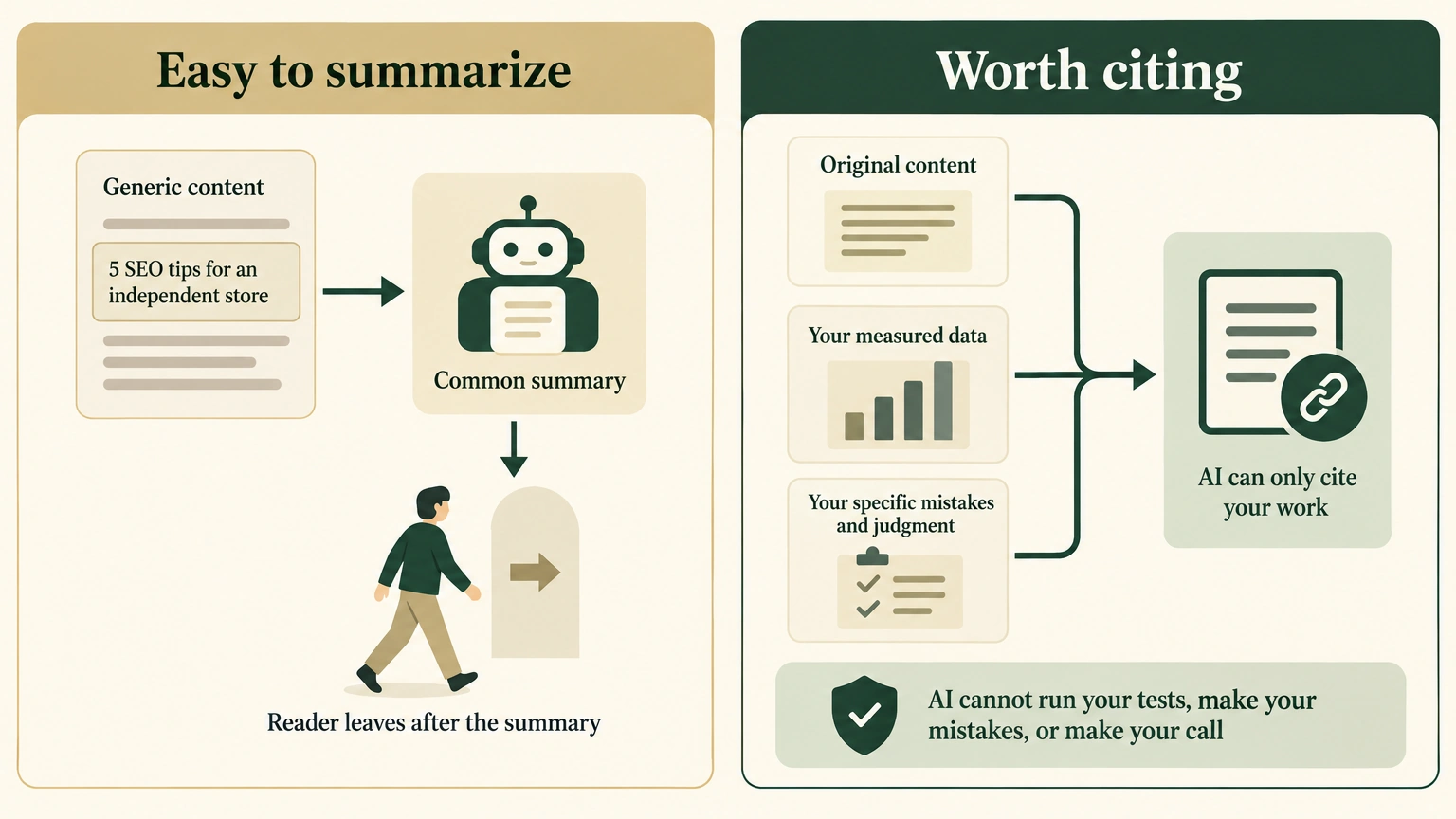
Generic summaries are easy to compress. First-hand evidence gives an AI system something it can only cite, not recreate.
Write “5 SEO tips for an independent store” and an AI system can turn it into one paragraph before a reader reaches your site. Write “How I used 14 days of real traffic to identify a Singapore bot pattern” and it does not have that data. It either links to your work or skips that piece. A bot is automated traffic that can imitate a person and inflate visit numbers.
That is the only defensible advantage I see as AI search grows: AI cannot run your tests, make your mistakes, or make your call. It can only repeat what you published. I am therefore raising the share of work I actually did in every article, even when that makes the piece narrower or shorter.
One forward-looking part of the guide
The first five sections pushed readers back toward the basics. Only the sixth, Explore agentic experiences, looked ahead. It suggested that AI agents, software that can click through a task on a user’s behalf, may eventually visit a site to order or make a booking. Google did not provide a specification. The implication is still clear enough: pages that let a program complete a journey smoothly may benefit first.
For an independent store, that means three practical checks:
- Keep important buttons out of scripts that appear only on mouse hover. Use ordinary HTML buttons that a machine can read.
- Keep URL structures stable instead of changing them casually.
- Let the add-to-cart and checkout path proceed step by step, without a series of extra elements that appear only after another click.
These are ordinary frontend fundamentals. This guide makes them easier to see as an entry condition for a future agent-led visit.
My current view
GEO has not disappeared. Google’s document pushed it back to where it belongs: SEO plus content that someone else cannot copy. Most GEO courses sold a different story. They turned anxiety about AI into a new checklist that seemed to require payment. Google’s guide says the underlying work has not changed. AI simply makes generic work easier to replace.
There is a reasonable counterargument. Google gives one platform’s view, while generative search can send traffic from other systems with different crawlers, interfaces, and citation behavior. A long-tail page or a machine-readable file may still have a purpose outside Google’s stated guidance. That is why I left the genuinely distinct variant pages open instead of deleting them on principle. Thirty days of data is the next test. The guide would be less useful to me if it made every non-Google search question disappear.
If I were checking an independent store’s content work this week, I would do three things:
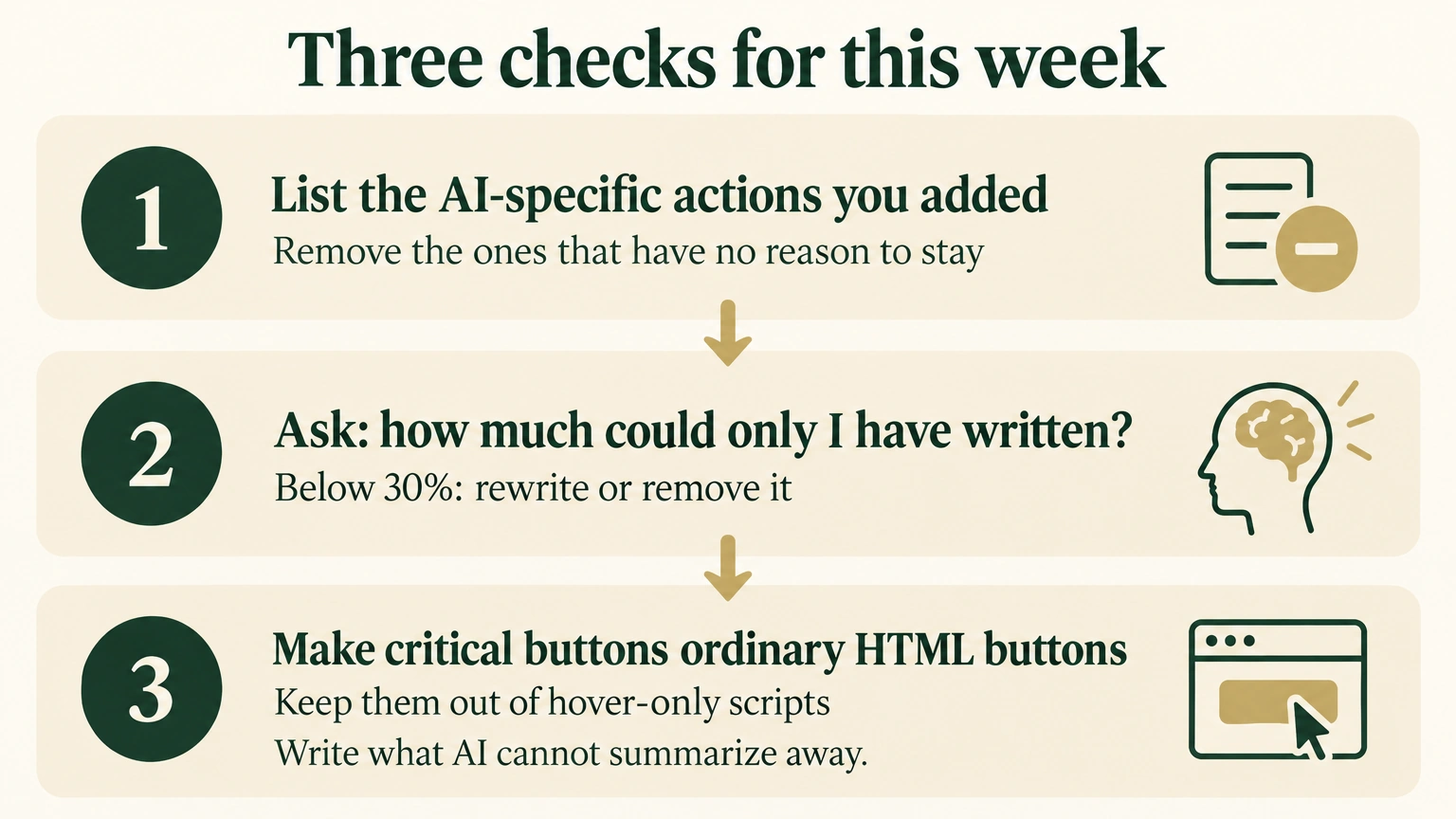
Review AI-specific tactics, measure how much of an article only you could write, and keep critical actions accessible through ordinary HTML.
- List the actions added for “AI optimization” in the past 12 months. Compare each one with the five items above and remove the ones that no longer have a reader or business reason.
- Pick an article you are proud of and ask how much of it only you could have written. If the share is below 30%, rewrite it or take it down.
- Check whether critical product-page buttons are ordinary HTML buttons. If they are not, change them back.
Do not rush after the next label. In a world where AI can summarize more and more, the advantage comes from material it cannot summarize away.
When a method makes you feel that you will be eliminated unless you adopt it immediately, look for the platform’s own wording first.
After I finished marking up the list, I did not feel that six months had been wasted. I felt relieved. I knew which work could leave the plan for the next year.
Original official source named in the source article: Google Search Central, AI Search Optimization Guide, May 15, 2026.